
18th Edition Exam Tips – A Complete Guide on How to Ace This Exam

In the UK, becoming a qualified electrician is not simple. Of course, you must pass several theoretical and practical exams to obtain the qualifications necessary to practise legally.
The current 18th Edition qualification is the City & Guilds 2382-26, and it is assessed against BS 7671:2018+A4:2026 — the Amendment 4 version of the IET Wiring Regulations, widely known in the trade as the Orange Book. It replaces the 2382-22, which has its final sitting on 15 October 2026 and is withdrawn from 16 October 2026.
The book aims to make you thoroughly aware of the regulations and safe practices governing electrical installations. It is not a tool that should be used to pass a test.
To assist you in passing your electrician exams on the first try, we’ve put together 15 top tips for the exam.
We will cover the 18th Edition exam tips in this article so you may confidently answer the questions.
Last reviewed: September 2026 — updated for BS 7671:2018+A4:2026.
Top Tips for the Requirements for Electrical Installations: 18th Edition Wiring Regulations Exam
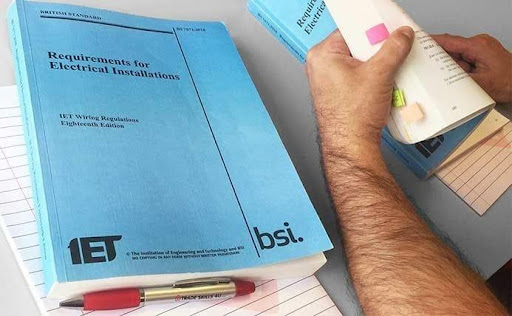
To become a qualified electrician in the UK, you must complete several written exams through open-book or closed-book assessments.
The 2382-26 examination has sixty multiple-choice questions and a time limit of two hours. That works out at an average of two minutes per question. It is an open-book assessment, delivered online and sat under invigilation — either at an approved centre or remotely with online invigilation, depending on what your centre offers.
The pass mark is 60%, which means 36 correct answers out of 60. Results are reported as a simple pass or fail, and there is no negative marking — so never leave a question unanswered. Sign up for these 18th Edition courses.
Protection for safety, assessment of general characteristics, and special installations or locations are a few of the topics you will cover during the assessment. Key protection topics include RCD protection under the 18th Edition and surge protection requirements.
Therefore, it’s essential to be as aware and prepared as possible. You can use the following methods to make sure you are ready and pass the exam:
1) Take the Right Book Into the Exam
This is the single most important thing on this list. The 2382-26 is assessed against BS 7671:2018+A4:2026 — the Orange Book. That is the copy you take in with you.
Do not take the previous brown book (BS 7671:2018+A2:2022+A3:2024) into a 2382-26 sitting. It is withdrawn on 15 October 2026 and from then no longer reflects the standard you are being examined on. Questions are set against Amendment 4, and several of them point at content that simply does not exist in the older book — you will be looking up answers that are not there, and burning your two minutes per question doing it.
Check the spine and the cover before you travel. If yours is brown, replace it.
2) Know What Changed in Amendment 4
You do not need to memorise Amendment 4, but you do need to know where the new material lives, because that is where the newer questions come from. Amendment 4 was published on 15 April 2026 and introduced:
- Chapter 57 — a new chapter on stationary secondary batteries used for electrical storage and supply
- Section 545 — a new section on functional earthing and functional equipotential bonding for information and communication technology (ICT) equipment and systems
- Section 716 — a new section on Power over Ethernet (PoE)
- Section 710 — a major revision of the requirements for medical locations, including recording the resistance of supplementary protective equipotential bonding conductors
- Inspection and testing — changes to the model forms in Appendix 6 and to how classification codes are applied on EICRs
Spend an hour finding each of these in your copy and tabbing them. If you already hold a 2382-22, the 18th Edition Amendment 4 update course covers this ground properly.
3) Consider the Study Seriously
Spend time thoroughly and focus on reading the rulebooks and textbooks.
To be able to respond to each exam question quickly, make sure you are familiar with the layout of BS 7671 — the parts, the chapters, the appendices and, above all, the index.
It would be best to do the work, because this well-planned preparation will be worth it.
4) Find Out Your Learning Style
It can be very helpful to be familiar with your preferred learning style, especially if it has been some time since you last had to take written exams.
For example, if you learn best visually, use flowcharts, mind maps, or different colours to revise.
If you learn best by listening, reading the regulations aloud or talking them through can help. Post-it notes and tabs may be a useful tool for helping physically oriented learners remember where things are.
5) Whether Online or in Person, Find a Study Companion
Collaboration with a study partner can be quite beneficial. Throughout the revision process, you can spur on and challenge each other.
6) Work From BS 7671 Itself, Not the On-Site Guide
Don’t revise from the On-Site Guide to begin with.
The On-Site Guide is a genuinely useful publication and you will get a lot out of it as you advance, but it is structured differently from BS 7671 and it is not what the exam questions are written against. Starting there will only confuse you.
If you are buying guidance publications, make sure you buy the Amendment 4 editions — the IET Guidance Notes and the On-Site Guide have all been reissued for BS 7671:2018+A4:2026.
7) Time Factors
The time allowed will let you think before choosing your answer. It is crucial to read the exam question carefully. But don’t spend too long on any one question, because time will fly by.
Many candidates make the mistake of “sense checking” every answer. Even when you are certain your answer is correct, there is little point searching the book for confirmation.
When in doubt, do check the book to support your answer — but move on to the next question as soon as you are confident in your response.
Unfortunately, over-checking causes many candidates to run out of time, so watch out that you’re not one of them.
8) Know What Is Expected
Make sure you’re clear on what you’re expected to know before the exam. By doing this, you’ll be as prepared as you can be for any question that may come up.
9) Be Aware of the Weighting of the Exam Questions
To make sure you devote the appropriate amount of time to each part of the paper, be aware that the topics are not weighted equally. Protection for safety, and selection and erection of equipment, carry the most questions.
Don’t rush through the areas with heavier weightings if you are short of time.
10) Breakdown of Sections
Identifying which subject sits in which part of the book is essential. The assessment draws on the following areas:
- The scope, object and fundamental principles of BS 7671
- The definitions given in BS 7671
- Assessment of general characteristics of an electrical installation
- Protection for safety
- Selection and erection of equipment
- Inspection and testing
- Special installations or locations
- The information provided in the appendices of BS 7671
Question counts and percentage weightings are not published per topic here, because they change between specifications and the figures that circulate online are usually lifted from a superseded one. If you want the exact breakdown for your sitting, ask your centre — they will have the current City & Guilds qualification handbook.
The 18th Edition Wiring Regulations can be found here.
11) Use Practice Tests and Mock Exams to Improve
Take as many practice tests and mock exams as you can.
Download your free information pack
Find out how you could train as a domestic gas and heat pump engineer with a free copy of our information pack.
Download information packAsk yourself questions, then look up the relevant regulation to find the answer. Make sure any mock you use has been updated for Amendment 4 — a mock written against the older book will teach you the wrong page numbers as well as, in places, the wrong answers.
As a result, there won’t be any surprises during the real thing. This is an excellent way of remembering regulations and how to find them.
These help you grow comfortable and confident with how the questions are presented, formatted and best answered.
It also helps you identify any knowledge gaps before the exam and highlights them.
You’ll quickly discover if you need to improve your knowledge and understanding of protective measures, particular regulations, or the calculations.
You can practise on this 18th Edition Mock Test by clicking here.
12) Use Test Simulators for Electricals
Testing simulators are excellent methods to gauge your knowledge and understanding while increasing your confidence.
An exam simulator will significantly improve your familiarity and confidence before the real assessment — again, check it has been updated for BS 7671:2018+A4:2026 before you rely on it.
13) Read the Question Properly
Though it seems straightforward, reading the question properly during the examination is the most crucial thing you can do.
One of the main reasons candidates fail is misreading the question.
Make sure you have read the question completely and accurately so that you can provide the correct answer.
14) Avoid Drag by Flagging!
There is a useful “flagging” tool built into the exam software that we advise you to use. You can mark any question you’re unsure about and want to check again later.
This enables you to proceed through the paper knowing you can revisit any areas of concern at the end of the test.
Never leave a question unanswered — there is no negative marking, so a considered guess costs you nothing and may gain you a mark. These “uncertain” answers can determine whether you pass or fail.
All of the questions are multiple choice. But don’t let that lull you into a false sense of security — working through 60 of them properly takes the full two hours.
15) Recognise the Pitfalls
It’s also essential to remember that some exam questions are deliberately phrased to test precision.
For example, the word “not” is easy to overlook if you don’t read carefully. Candidates frequently identify the correct practice when the question actually asked for the incorrect one.
Questions also reference specific passages in the book using precise terminology. If you have looked up a nearby regulation rather than the one being asked about, your answer will be wrong even though your reasoning was sound.
Nonetheless, if you are well-versed in the material, this aspect of the exam format will help you rather than hinder you.
Work any calculations out on the rough paper you are given, then select your answer. The assessment is marked automatically, so nobody reads your workings — but writing them down keeps you accurate and stops you selecting the option that is one decimal place out.
Although it’s a difficult thing to do, students shouldn’t let their scores during revision worry them too much. Your score will take care of itself if you are satisfied that you understand the book’s ideas and how to apply them.
Frequently Asked Questions (FAQs)
The frequently asked questions regarding the 18th Edition exam are listed below:
Which Book Do I Take Into the Exam?
BS 7671:2018+A4:2026 — the Orange Book. Amendment 4 was published on 15 April 2026, and the previous version (BS 7671:2018+A2:2022+A3:2024, the brown book) is withdrawn on 15 October 2026.
The exam is open book, so your copy of BS 7671 goes in with you. Check with your centre in advance about anything else you plan to bring, such as tabs or a calculator.
Is My Existing 2382-22 Certificate Still Valid?
Yes. If you hold the 2382-22, your qualification remains valid and does not expire — you do not need to resit.
However, from 15 October 2026 all new installation work, alterations, additions and periodic inspections are assessed against Amendment 4, and competent person schemes expect you to be conversant with the changes. An Amendment 4 update course is the efficient way to get current without repeating the full qualification.
Should I Read Through the 18th Edition Book First?
It seems counterintuitive, but you should complete your first run-through of a mock with the book closed. This will encourage you to review questions without getting caught up in the text.
Is a Certificate Required in the UK for Electrical Work?
Any job, no matter how big or small, should come with an electrical installation certificate from your electrician.
This attests that the work was completed in accordance with BS 7671, the standard for electrical safety. Building Regulations cover electrical work in dwellings.
How Challenging Is the 18th Edition?
BS 7671 isn’t an easy read. Standard textbooks for classes or courses may feel familiar, yet this book is different.
It can be challenging because of how it is organised and the language used. That is exactly why familiarity with the layout matters more than memorising content.
Conclusion
A well-rounded exam strategy will make you feel considerably more prepared before taking the 2382-26.
A solid understanding of the book’s ideas will set you up for success; memorising specific regulations or reciting individual sentences will not.
Don’t just think of the information as words on a page — think about applying it.
With the right study, revision and exam preparation, expect to pass on your first attempt.
Hopefully the above will make you feel more equipped to approach the 18th Edition exam with confidence. All the best!
Become a qualified gas engineer
Our New Entrant Gas Engineer courses take you from beginner to Gas Safe registered, with hands-on training and the ACS qualifications employers look for.
Blog categories
Keep up to date with the latest news from
Skills training group.